Showing posts with label 1001. Show all posts

Monday, October 14, 2013

September 2013 Books

This month, my reading of WWII has focused on individuals and their contribution to what will hopefully be known as the last World War.  In addition, I have given myself a huge pat on the back for finishing Tolstoy's epic War and Peace.

Double Cross: The True Story of the D-Day Spies by Ben Macintyre
Published: 2012
Rating: 4
Goodreads

My brother has a condo on Stratton Mountain, VT and whenever I visit, a trip to my favorite bookstore (Northshire) is an absolute must.  I am never disappointed.

Take this book, for example.  I've perused the WWII section of numerous bookstores and have never come across this gem.  But being prominently displayed at Northshire, it caught my attention.  I was hooked after the first couple of pages and finished it within a few days.  It reads like fiction, similar to Truman Capote's nonfiction fiction: In Cold Blood.  I would highly recommend.

In fact, two novelists who have written about WWII had this to say:

"How on earth, in 1944, did we dupe Berlin that we would attack the coast of France in completely the wrong place?  It was a deception that saved tens of thousands of Allied lives. In Double Cross, Ben Macintyre ingeniously explains exactly how it was done."    Frederick Forsyth

"Never before revealed facts about the workings of the Intelligence Service in the build-up to D-Day in the Second World War.  Ben Macintyre's remarkable book is a gripping revelation."  Jack Higgins

Two epigraphs:
Tangle within tangle, plot and counter-plot, ruse and treachery, cross and double-cross, true agent, false agent, double agent, gold and steel, the bomb, the dagger and the firing party, were interwoven in many a texture so intricate as to be incredible and yet true.
Winston Churchill 
The enemy must not know where I intend to give battle.  For if he does not know where I intend to give battle he must prepare in a great many places.  And when he prepares in a great many places, those I have to fight in any one place will be few.  And when he prepares everywhere he will be weak everywhere.
Sun Tzu
Other WWII espionage books by Macintyre:
  • Agent Zigzag
  • Operation Mincemeat

Audiobook - Hell in the Pacific: A Marine Rifleman's Journey from Guadalcanal to Peleliu by Jim McEnery with Bill Sloan
Published: 2012
Rating: 4
Goodreads

I found this audiobook at my local library and would highly recommend.

An honest, simply written memoir about an enlisted Marine's journey to hell and back.  Mac was in K/3/5 (K Company, 3rd Battalion, 5th Marine Regiment, 1st Marine Division) and fought at Guadalcanal and Cape Gloucester (like Robert Leckie of Helmut for My Pillow) and at Peleliu, where he met E.B. Sledge, author of With the Old Breed.  

Published in 2012, this may be the last memoir published by a surviving WWII veteran - see video.   

What the young Marines endured in the Pacific campaign is beyond belief: horrible conditions, little food and water, malaria, jungle rot, constant fear, lack of sleep, seeing best friends die, close combat with K-bar (knife) and bayonets, knowing that you either "kill or be killed."  Mac eventually grew numb to the killing by considering it "his job".  It is what he had to do; it is what he was ordered to do.

His disdain for Army General, Douglas MacArthur or "Dougout Doug" (his infamous nickname after escaping to Australia), is palatable.  It is MacArthur that ordered the invasion of Peleliu, to cover his flank during the Allied invasion of the Philippines, resulting in thousands of Marine casualties.  In retrospect, the securing of the island was unnecessary.

Despite everything, it is clear that he is proud of being a Marine and especially proud of their stand on Guadalcanal, the first US offensive after Pearl Harbor, thereby being the first real test of green Marines.  The Japanese thought the "soft" Americans would turn and run.  Little did they know what courage, stamina, bravery and heroism lay in the soul of those extraordinary "greatest generation" citizen soldiers.


War and Peace by Leo Tolstoy
First Published: 1869
Oxford University Press/Translated by Louise and Aylmer Maude/Intro and notes by Henry Gifford
Rating: 5
Goodreads

Pending - to contemplate writing a blurb about this epic work is a bit overwhelming.  


Wings of Morning: The Story of the Last American Bomber Shot Down Over Germany in World War II by Thomas Childers
Published: 1996
Rating: 5
Goodreads

Childers is a history professor at the University of Pennsylvania and delivers one of my favorite audio courses produced by The Teaching Company: World War II: A Military and Social History.  

I LOVED this book and plan to read his other two WWII books: In the Shadows of War: An American Pilot's Odyssey Through Occupied France and the Camps of Nazi Germany (2003) and Soldier From the War Returning (2009)

Two epigraphs:
If I take the wings of the morning, and dwell in the uttermost parts of the sea;
Even there shall thy hand lead me, and thy right hand shall hold me.
If I say, surely the darkness shall cover me, even the night shall be light about me.
Yea, the darkness hideth not from thee, but the night shineth as the day....
Psalm 139
And in the end, of course, a true war story is never about war.....
It's about love and memory. It's about sorrow
Tim O'Brien, The Things They Carried
The subject of this book, the bomber Black Cat and her crew, shot down days before the war's end is very personal to Childers as the radio operator was his uncle, Howard Goodner.

While going through his deceased grandmother's possessions, Childers discovered a pack of letters and photographs, postmarked 1943 - 1945.  One picture was of the Black Cat crew; 11 young men in the prime of life, dressed to fly, smiling in front of their plane.  It graces the book's cover (not sure why is does not show up here).   This discovery began a three year journey, taking the author to multiple states as well as a deserted English air base and small town's field in Germany.

The writing is immediate; the reader is right there, experiencing the long training of a bomber crew, the GI experience as part of the 8th Air Force stationed in England, flying the cumbersome Liberator B-24's, the milk runs, the harrowing runs, the frigid winter of 1944, the physical, emotional and mental challenge of flying bombing missions, the added pressure as the lead crew, the fateful last run and the author's quest to discover the truth.  Here are some of my favorite quotes:

About the never-ending British rain:
And, most mystifying and maddening of all, it came in the form so fine they could never feel anything as distinct as a drop, so invisible it failed to stir even the placid surface of a puddle, and yet after walking ten yards their faces, their jackets, their caps would be drenched as if they had somehow generated the moisture from some elusive internal source.
Preparing fore the Black Cat's first official run:
...the atmosphere was subdued, somber, as if each man in the crowded room had deserted the present and crawled into a small, secret space just behind his eyes.
 and
.....these final few minutes before takeoff crawled by, caught in the undertow of time.
 While on leave, walking alone in London, after being with his crew 24/7 for months:
It was a dreamy, luxuriant feeling, this fleeting sensation of solitude, of privacy, a sensation that belonged to another lifetime, like the simple, sensual steam of a shower.

Goodbye Darkness: A Memoir of the Pacific War by William Manchester
Published: 1979
Rating: 4
Goodreads

William Raymond Manchester is a renowned biographer, most known for American Caesar: Douglas MacArthur 1880-1964 and The Last Lion trilogy on Winston Churchill.

But as a young 23-year old Marine sergeant, he fought in one of the bloodiest engagements of the Pacific Theatre: Okinawa.

Three epigraphs:
Your old men shall dream dreams,
your young men shall see visions.
Joel 2:28 
War, which was cruel and glorious,
Has become cruel and sordid.
Winston Churchill 
But we....shall be remembered:
We few, we happy few, we band of brothers;
For he to-day that sheds his blood with me
Shall be my brother, be he ne'er so vile,
This day shall gentle his condition.
Henry V, Act IV, Scene iii
This is an interesting and intensely personal memoir.  In fact, it is a memoir of the quest to access the horrors of war which he had tried in vain to write about for years.  The memories were too deep for conscious recollection but manifested themselves in troubling dreams of a split persona - "the scrawny, Atabrine-yellow, cocky young Sergeant of Marines who had borne my name in 1945.  The other was the portly, balding, Brooks-Brothered man who bears it today."

The solution was self-evident - he would have to travel back to the Pacific.  So thirty-three years after the end of the war, Manchester embarks on an island-hopping journey to visit the sites of all the major engagements, beginning at Pearl Harbor to Corregidor, Guadalcanal, Tarawa, Saipan, Guam, Peleliu, Leyte, Manila, Iwo Jima and finally, Okinawa.  As a Marine, he served at two places: Guadalcanal (after the island was secured) and Okinawa.

So it is an unusual memoir with intermingled parts: 1) the sequential account of the war, 2) description of the impact three decades had on these "killing fields", 3) vivid accounts of Manchester's personal experience in Okinawa and 4) reconciliation of his split persona.

 To gain a better understanding of the somewhat complicated structure of this unique memoir, I will need to take pen to paper and write an outline and/or a chapter-by-chapter synopsis.

Sunday, December 4, 2011

November 2011 Books and Audiocourse

It is now December 4th and with the addition of the books/course below, I am just eight books away from reaching one hundred in 2011.  I have never come close to reading this many books in one year - ever.  This underscores how vital books have been to my grief journey.  I am in full agreement with Thomas Jefferson's famous quote: I cannot live without books.

The Art of Fiction: Notes on Craft for Young Writers by John Gardner
Published: 1983
Rating: 3
Goodreads review
I would like to be a more discerning reader so have collected a number of books such as this one - books that describe how fiction works.  I also have some story ideas percolating in my head, that one day I may try to write.  For the more experienced fiction/creative writers, this may be just what you are looking for.  But for me, the ultra novice, "don't know what I am doing" wanna-be-writer, it was difficult to get through.

Blue Nights by Joan Didon
Published: 2011
Rating: 3
Goodreads review
A short memoir by a well known author who has suffered multiple losses within a short period of time.  On December 30, 2003, while her adult daughter Quintana was in the hospital overcoming a life-threatening infection, her husband died from a sudden heart attack.  Then on August 26, 2005, the proverbial "other shoe" dropped as her daughter, who suffered complications from the initial infection, died.  In October, 2005, she published a moving memoir about her first loss, The Year of Magical Thinking - reviewed in this post.

It is evident that writing Blue Nights helped Didion process her daughter's death.  She asks many unanswerable questions. She thinks of other friends who have died. She reviews specific memories and ponders their significance.  Why does she remember these and not others?  She allows these memories to trigger others and so leads the reader down a meandering path of events that occur in real time, the recent past and the way, way past.  She ponders aging and dying.  A quick and moving read.

On a side note, this is the first book that I read on my new iPad and loved the experience.  I like the large screen and the highlighting and note-taking capability.

My Brother by Jamaica Kincaid
Published: 1997
Rating: 3
Goodreads review
I bought this book from a public library book sale in Charlottesville, VA while visiting my daughter.  Kincaid is another writer who has penned a memoir about loss - her brother who died of AIDS in Antigua on January 19, 1996.  This memoir chronicles a complicated grief because she has a very angry, hateful and unresolved relationship with her mother which gets in the way of her feelings for her brother.  Her thoughts stream together in long sentences which I sometimes found difficult to follow but at other times, were beautiful and brilliant.  She has unique thoughts on death that has made me think.

Annie John by Jamaica Kincaid
Published: 1981
Rating: 3
Lists: 1,001
Goodreads review
I bought Kincaid's book at The Book Rack, a used bookstore in S. Yarmouth, MA this past summer and decided to read it after finishing her memoir, My Brother.  It is a short book, only 148 pages, which I read in one day.  It is a coming of age story - about an only child, Annie John, born to a beautiful mother whom she first adores and then comes to hate/love - sound familiar?  Telling quote: My mother would kill me if she got the chance.  I would kill my mother if I had the courage."  Yikes!  The consequence of this dysfunctional relationship is severe as Annie suffers from deep depression and what I would call a breakdown.  My unhappiness was something deep inside me, and when I closed my eyes I could even see it....It took the shape of a small black ball, all wrapped in cobwebs."   It was painful to read about a love-hate relationship between mother and daughter again.

Anne of Green Gables (#1) by L.M. Montgomery
Published: 1908
Rating: 5
Goodreads review
This has been sitting on my bookshelf since January 2011 when I bought it at a local library book sale.  I was looking for something light and fun to read after finished some pretty heavy books and this did the trick - I loved it!  For some reason, I was ready to fall in love with Anne Shirley, eleven-year old orphaned girl who went to live with an older spinster couple, Matthew and Marilla Cuthbert on their farm, Green Gables located on rural Prince Edward Island, Canada.  At the end of chapter 8, about 20% into the book, I wrote down the following reasons of why Anne was such an engaging character:  innocent, vivid and real imagination, curious, gumption, honest, love of life, she sees beauty in nature that is missed by others, bright and articulate, unpretentious, a reader and a true romantic.  The book follows her many adventures and was so successful with early 20th century readers that Montgomery ended up writing a series, which I happily plan to read.  UPDATE:  I watched the 1985 made-for TV movie starring Megan Follows in the title role.  I loved it so much that I have watched both sequels.

Persuasion by Jane Austen
Published: 1817
Rating: 5
Goodreads review
Jane Austen web site
Jane Austen Society of North America
I decided to read this in keeping with the unplanned "Anne" theme as I've  recently read Anna Karenina, Annie John, Anne of Green Gables - why not another book featuring an Anne?  I initially gave it a 4 (as how could any book match the beloved Pride and Prejudice), but changed it to a 5 because after finishing, I didn't want the story to end.  So I researched what good sequels were out there, found one by Amanda Grange (below), paid full price ($12.99 for the ibook), downloaded and read in one day.  I also rewatched the movie with Rupert Penry-Jones as the handsome and dashing Captain Wentworth and Sally Hawkins as the heroine, Anne Elliot.  I look forward to reading Austen's other three books: Sense and Sensibility, Mansfield Park and Northanger Abbey.  A Google search shows numerous sites created for Jane Austen fans and a Society called the Jane Austen Society of North America or JASNA - who knew?

Captain Wentworth's Diary by Amanda Grange
Published: 2007
Rating: 4
Goodreads review
Author's web site
Authors's Goodreads blog
Grange has written a number of Austen male protagonist diaries, starting with Mr. Darcy's Diary (2007).  See this interesting online interview on her decision to do so.  I found Grange's version of when Anne and Frederick Wentworth initially fell in love completely believable.  It is a satisfying companion to Austen's original.


The English Novel  by Professor Timothy Spurgin
Audiocourse by The Great Courses
Rating: 5

Borrowed from the library, I had high hopes for this course based on his other course, The Art of Reading.  I listen to the CD's while driving so one requirement is that they are interesting and this did not disappoint. This course begins with what is typically regarded as the first English novel, Pamela (1740) by Samuel Richardson and ends with notable contemporary works by Ian McEwan, Salman Rushdie and Zadie Smith.  18th century books such as Tom Jones (1749) by Henry Fielding, Tristam Shandy (1759-1767) by Laurence Sterne and The Mysteries of Udolpho (1794) by Ann Radcliffe have been added to my TBR pile.  Works by Sir Walter Scott (Waverly 1814) and Henry James (The Portrait of a Lady 1881) join other 19th century "to-be-read" authors: Austen, Bronte, Dickens, Thackeray and Eliot.  In Spurgin's discussion of a particular novel, he not only talks about the work itself, but spends time on the author's biography and the time period in which he/she wrote.  He ties in critical historical and social events that influence the writer and the work.  His love for literature is evident and so each lecture was a pleasure to listen to.  I would highly recommend.

Tuesday, November 15, 2011

October 2011 Books - Voices of Women (and Tolstoy)

I went on a vacation in early October and underwent the usual turmoil of trying to decide what books to bring with me.  In the end, I decided to focus on women writers.  For some reason, I wanted to hear their voices, their thoughts and absorb whatever lessons they had to teach.  I enjoyed most of my choices.  This exercise has only served to make me want to read more from other women authors.  Tolstoy is included because I started Anna Karenina in September and finished in October.

The Undomestic Goddess by Sophie Kinsella
Published: 2005
Rating: 3
Goodreads review
I bought this book at a local library book sale and brought it with me on vacation because I knew it would be a fast and fun read - brain candy.  It did not disappoint but my favorite by Kinsella is still Can You Keep A Secret?  I read that book while in Europe with my daughters, where at the end of each exhausting day, feet sore from sight-seeing, we curled up in bed, engrossed in our own books.  Interesting how books can be part of vacation memories and experience.


Fear of Flying by Erica Jong
Published: 1973
Rating: 5
Lists: 1,001
Goodreads review
Bought at a local library book sale because it is one of the 1,001 Books You Must Read Before You Die.  I loved it.  For some reason, because of where I am in life, the book was life changing.  It is hard to condense the impact of this book in a small paragraph so I won't even try.  Suffice it to say that my journal is full of thoughts and one day, maybe I will write a proper post.  Or now that I think of it, maybe not as it is quite personal.  We'll see.


their eyes were watching god by Zora Neale Hurston
Published: 1937
Rating: 5
Lists: 1,001, TIME 100 Best Novel
Goodreads review
I got this book off my daughter's bookshelf, (she had to read it for a college course), and I loved it.  The reader must get used to the very strong, Southern, black slang dialogue which is contrasted to and interspersed with an extremely  literate narrator. Very interesting.  The imagery is wonderful.  The protagonist, Janie Crawford follows her heart, for better or for worse.  Her story moves quickly and succinctly - beautifully written and constructed.  The pace is perfect.  Would highly recommend.


The Writing Circle by Corinne Demas
Published: 2010
Rating: 2
Goodread review
Bought this book at a Border's closing sale as I am interested in books about writers, even if it is fiction.  If writing clubs are anything like what is described in this book, I will pass.


His Bright Light: The Story of Nick Traina by Danielle Steel
Published: 1998
Rating: 3
Goodreads review
Best-selling author writes about the challenges of raising her handsome and talented son, Nicky, who suffered from manic depression. At nineteen, he took his life.  Her goal in writing was to 1) preserve her son's memory and 2) help parents who are trying to raise a child with severe emotional issues.  As a mother who also lost her son to suicide, I could relate to her pain and grief even though her story is very different than mine.


The Stone Diaries by Carol Shield
Published: 1993
Rating: 4
Lists: Pulitzer Prize (1995), 1001
Goodread Review
A beautifully written book about an ordinary woman leading an ordinary life.  It is about good and bad marriages.  About how sex does not equal love.  About how much women want what I now call "The Dream" - romantic love.  And how hard it is to find.


Jane Austen by Carol Shields
Published: 2001
Rating: 3
Goodreads review
Bought at the overwhelmingly huge NYC city bookstore, The Strand this past summer.  I decided to read it after finishing The Stone Diaries by the same author.  A short book - it is a quick, enjoyable read for any Jane Austen fan.


Anna Karenina by Leo Tolstoy
Translated by Richard Pevear and Larissa Volokhonsky
Published: 1873
Lists: 1,001
Rating: 4
Goodreads review
A fascinating book of love, lust, anger, revenge, hope and fear - basically every human emotion is felt by one or more characters.  The world of high society is contrasted with the simple country life.  Psychological, sociological and cultural issues which could be cumbersome to the reader, are masterfully explored by Tolstoy. The stream of consciousness technique depicting Anna's tragic thoughts at the end of the novel, before the infamous suicide, feels so real.  I am glad to have read this particular translation and would highly recommend.

Saturday, August 20, 2011

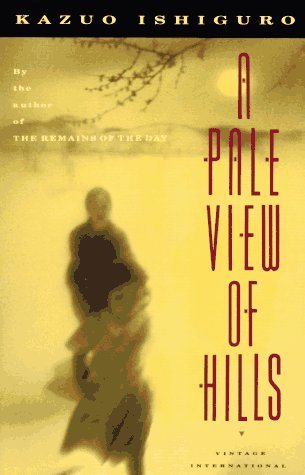
"A Pale View of Hills" by Kazuo Ishiguro

Published: 1982
Read: 2011
Genre: Fiction
Rating: 3
Lists: 1,001 books
Review: Goodreads


Ishiguro's first novel is haunting, reminding me of his other beautifully written work, Never Let Me Go, published in 2005.  In both books, a female narrator tells of what happens in her past.

Although I loved the prose, the narrative was frustrating.  I had lots of questions while reading which remained unanswered and after finishing, I wrote in the margin, "I don't get it - at all."  In situations like this, I rely on Goodreads and found that many others felt the same way.

Halfway through the book I questioned whether or not Etsuko Sharingham was a reliable narrator.  But I think the true question Ishiguro is exploring is would any of us be a reliable narrator in the same situation?  He answers via her musing:
Memory, I realize, can be an unreliable thing; often it is heavily colored by the circumstances in which one remembers, and no doubt this applies to certain of the recollections I have gathered here.
Is the same message within the title?  In my journal, while thinking of the word "pale" and with a thesaurus' help, I wrote the following:  washed out, weak, fragile, dim, faint, feeble, muted, faded, subtle and soft.   After reading the book, I think the title suggests that views of the past expressed in the book will be dim, faint, and muted or in other words, "pale".

Etsuko is a widow, living alone is some English village and at the beginning of the book, her daughter Niki, who lives in London is visiting.  We find out that six years earlier, Keiko, her daughter via her first husband, committed suicide while living in Manchester (horrible - she hung herself and was not found until a few days later).  Prior to that, Keiko lived at home but in self-imposed isolation from her family.  She did not interact with anyone, not her mother, step-father or step-sister...for years.  Very strange, bizarre behavior.  Why was this tolerated?

It is during Niki's visit that the story is told.  Etsuko's memories are prodded after some discussions with Niki about  the past.  An image of a little girl playing on a swing, seen while they are at a teashop, sticks with Etsuko, invades her dreams and causes her to remember people and situations when she lived in Japan.  So the narrative swings from present to past and in the end, is all tied to Keiko's suicide.

Within Etsuko's memories is another question that Ishiguro explores: what are the consequences of a mother's guilt?  In her case, was it so great, so intolerable, that she had to invent an alternate mother (Sachiko) and daughter (Mariko) in order to remember the past?  Is it possible for a person to disassociate from themselves so much that they create a fictional reality?  Maybe.  To me, this is a disturbing question.

As a survivor of suicide myself, I found this passage to be tragically true:
I have found myself continually bringing to mind that picture - of my daughter hanging in her room for days on end.  The horror of that image has never diminished but it has long ceased to be a morbid matter; as with a wound on one's own body, it is possible to develop an intimacy with the most disturbing of things.
I would recommend this book with the following caveat - beware of unanswered questions and an ambiguous ending.  If you do read it, I'd love to hear your thoughts.

Tuesday, August 9, 2011

"To Kill A Mockingbird" by Harper Lee

Published: 1960
Read: 2011
Genre: Fiction
Rating: 5
Review: Goodreads
Lists: Pultizer Prize (1961); 1,001 books


Harper Lee’s first and only novel published in 1960 was an immediate success, winning the Pulitzer Prize in 1961 and made into a movie with Gregory Peck as Atticus Finch in 1962 (in my Netflix queue). 

The story is told in the first person by an older Scout, looking back on her life growing up in Maycomb, Alabama with her father whom she calls Atticus, her older brother, Jem and their cook, Calpurnia.  Her mother died when she was young.  She is a likable protagonist, a tomboy with spirit, gumption and a lively imagination.  The most excitement in their idyllic, sheltered life comes from trying to draw out the reclusive and mysterious Boo Radley until Atticus takes on a case which polarizes the community and brings racial tension straight into Jem and Scout’s world.  In short. Atticus is asked to defend Tom Robinson, an innocent black man accused of raping a “white trash” young woman.  There are no witnesses, it is her word against his.

While I have wanted to read this book after finishing other books about adolescents such as Twain's The Adventures of Tom Sawyer and The Adventures of Huckleberry Finn, and J.D Salinger's The Catcher in the Rye, it went to the top of my TBR list after seeing her name in the dedication page of another recently read book, In Cold Blood by Truman Capote.  In fact, To Kill a Mockingbird is somewhat autobiographical as Lee grew up in the Deep South, loved to read (like Scout), her father was a lawyer (like Atticus) and one character, Dill was modeled after Capote.

Moral lessons abound within this quick read:

Atticus to Scout – on trying to teach her how to get along with people she may not agree with or understand:  
You never really understand a person until you consider things from his point of view…until you climb into his skin and walk around in it.

Miss Maudie (neighbor) to Scout about Atticus: 
"Atticus Finch is the same person in his house as he is in public" and "People in their right minds never take pride in their talents."
Atticus to Scout on why he took the Robinson case: 
"This case, Tom Robinson’s case, is something that goes to the essence of a man’s conscious.  I couldn’t go to church and worship God if I didn’t try to help that man" and "before I can live with other folks I’ve got to live with myself.  The one thing that doesn’t abide by majority rule is a person’s conscious."
Jem and Scout had watched the trial and with the black/white and right/wrong idealism of youth, he was angry at the verdict. Atticus' explanation to Jem:
The one place where a man ought to get a square deal is in a courtroom, be he any color of the rainbow, but people have a way of carrying their resentments right into a jury box.  As you grow older, you’ll see white men cheat black men every day of your life, but let me tell you something and don’t you forget it.  Whenever a white man does that to a black man, no matter who he is, how rich he is, or how fine a family he comes from, that white man is trash.
When Jem and Scout are talking about classes in Southern society: 
J – I’ve thought about it a lot lately and I’ve got it figured out.  There’s four kinds of folks in the world.  There’s the ordinary kind like us and the neighbors, there’s the kind like the Cunninghams out in the woods, the kind like the Ewells down at the dump and the Negroes. 
S - Naw, Jem, I think ther's just one kind of folks.  Folks.
J - That's what I thought too when I was your age.  If there's one kind of folks, why can't they get along with each other?  If they're all alike, why do they go out of their way to despise each other?
Notable passages

For some reason, I love this sentence (about Aunt Alexandra's husband):
She married a taciturn man who spent most of his time lying in a hammock by the river wondering if his trout lines were full.
About Dill:
Thus we came to know Dill as a pocket Merlin, whose head teemed with eccentric plans, strange longings, and quaint fancies.
Great description of Maycomb (long but I couldn't pare down - all good):
Maycomb was an old town, but it was a tired old town when I first knew it.  In rainy weather the streets turned to red slop; grass grew on the sidewalks, the courthouse sagged in the square.  Somehow, it was hotter then: a black dog suffered on a summer's day; bony mules hitched to Hoover carts flicked flies in the sweltering shade of the live oaks on the square.  Men's stiff collars wilted by nine in the morning.  Ladies bathed before noon, after their three-o'clock naps, and by nightfall were like soft teacakes with frostings of sweat and sweet talcum.
People moved slowly then.  They ambled across the square, shuffled in and out of the stores around it, took their time about everything.  A day was twenty-four hours long but seemed longer.  There was no hurry, for there was nowhere to go, nothing to buy and no money to buy it with, nothing to see outside the boundaires of Maycomb County.
On Scout's second cousin:
Talking to Francis gave me the sensation of settling slowly to the bottom of the ocean.  He was the most boring child I ever met.
When Jem and Scout visited Calpurnia's church:
The warm bittersweet smell of clean Negro welcomed us as we entered the church yard - Hearts of Love hairdressing mingled with asafoetida, snuff, Hoyt's Cologne, Brown's Mule, peppermint, and lilac talcum.
On why Aunt Alexandra was so irritable on the Lord's Day:
I guess it was her Sunday corset.  She was not fat, but solid, and she chose protective garments that drew up her bosom to giddy heights, pinched in her waist, flared out her rear, and managed to suggest that Aunt Alexandra's was once an hour-glass figure.  From any angle, it was formidable.
On being a Southern woman:
Why ladies hooked woolen rugs on boiling nights never became clear to me.
I must soon enter this world, where on its surface fragrant ladies rocked slowly, fanned gently and drank cool water.

Saturday, July 16, 2011

"In Cold Blood" by Truman Capote

Published: 1965
Read: 2011
Genre: Non-fiction novel or true crime novel
Rating: 5
List: 1,001
Review: Goodreads, A Guy's Moleskin Notebook


With this brilliantly written novel, Capote created a new genre: the non-fiction novel and/or the true crime novel.  It was initially published in four installments in the New Yorker and then in novel form in 1965.  Rather than writing a book full of facts about a horrific crime in a sleepy Midwestern town, Capote used these facts to create a spell-binding story.  Once started, I had a hard time putting the book down.  

The book is divided into four parts called I) The Last to See them Alive, II) Persons Unknown, III)  Answer and IV)  The Corner.  Within the parts are sections separated by white space, no chapters.

Capote and Harper Lee (author of To Kill A Mockingbird) went to Holcomb, KS, scene of the gruesome murders to conduct interviews.  He followed the story through the trial/sentencing and was able to interview the murderers while incarcerated.   There are two movies that depict this time in Capote's life, Capote and Infamous.  Both are in my Netflix queue.

Quotes to remember and why:

Rather than just listing items that accompany a guitar and 12-guage shotgun in the back seat of the car, Capote adds a literary flair:
A flashlight, a fishing knife, a pair of leather gloves, and a hunting vest fully packed with shells contributed further atmosphere to this curious still life.
If Dick's face truly looked like this, what a piece of descriptive writing:
...his face, which seemed composed of mismatching parts.  It was as though his head had been halved like an apple, then put together a fraction off center.
Even a cat is worthy of a well-constructed sentence:
Pete, a tiger-shaped tom weighing fifteen pounds, is a well-known character around Garden City, famous for his pugnacity, which was the cause of his current hospitalization; a battle lost to a boxer dog had left him with wounds necessitating both stitches and antibiotics.

This reminds me of Josh's glasses that are still in his room....
Upstairs in Kenyon;s room, on a shelf above his bed, the lenses of the dead boy's spectacles gleamed with reflected light.

When locals were getting on Dewey for not solving the crime at Hartman's cafe, Mrs. Hartman rebukes them with these three simple words which says it all.
Hush your meanness.
Dewey had worked on four simple murder cases before this one. I like how clear and concise this sentence is:
Prior to the Clutter mystery, the four cases cited were the sum of Dewey's experience with murder, and measured against the case confronting him, were squalls preceding a hurricane.
How Perry looked at the trial in a borrowed shirt and jeans cuffed at the bottom:
..he looked as lonely and inappropriate as a seagull in a wheat field.
Death, grief and suicide are prominent themes so I wrote a post on Josh's blog.

Thursday, June 30, 2011

"The Catcher in the Rye" by J. D. Salinger: Read-A-Long

Published: 1951
Read: 2011
Genre: Fiction
Setting: NYC 1949
Rating: 5
List: 1,001
Review: Goodreads


Love it, love it, love it.  And I am only in the first couple chapters.  I hope this love affair will continue.  Because I am getting so much out of my reading, thinking and journaling through the chapters, I want to take my time.  So it will be my own "read-a-long" with no structure or deadline.  The links to the posts (on Josh's blog) are below.

Chapters 1-3   (posted 6/7/11)
Chapters 4 - 10  (posted 6/13/11)
Chapters 11 - end   (posted 6/30/11)

This book reminds me of The Adventures of Huckleberry Finn by Mark Twain as both protagonists are adolescent boys who are non-conformists at heart, challenging and rebelling against social expectations, not because they are bad but more because they do not see the point.  They look at adults with skepticism and distrust, having seen clear evidence of hypocrisy and in Holden's word, phoniness.

Twain and Salinger excel at capturing the thoughts, musings and speech of the boys, each in their respective time periods. Of the two master plots in fiction, "stranger comes to town" and "hero takes a journey", both are the latter.

I would re-read, but for different reasons.  Twain's story chronicles the adventures of Huck and Jim, a run-away slave, as they travel down the Mississippi River on a raft.  Although Huck is an uneducated, homeless boy, his honest, simple and genuine character shines through, making for a "feel good" story.

Salinger's story is much darker.  Holden is alone in his journey which leads him to an increasingly depressed state.  My interest this book stems from trying to glean whatever I can, via fiction or non-fiction sources, the fragile state of an adolescent boy's mind.  To help me better understand what could've been going on in my beloved boy's head.

Takeaways:  Read other books about adolescents

  • To Kill A Mockingbird by Harper Lee
  • Anne Frank: The Diary of a Young Girl by Anne Frank

Thursday, June 16, 2011

"The Big Sleep" by Raymond Chandler

Published: 1939
Read: 2011
Genre: Fiction  Hard-boiled detective
Setting: Los Angeles
Rating: 3
Lists: TIME's 100 Best Novels (2005), 1001 books
Review: Goodreads


I wanted to read this after reading The Maltese Falcon by Dashiell Hammett.  Both are hard-boiled detective stories featuring iconic protagonists, Sam Spade and Philip Marlowe.  Both authors wrote their novels after first submitting well-received short stories for the immensely popular pulp-fiction magazine, the Black Mask. 

The book I checked out from the library was interesting.  According to information on the last page, it was one of 425 copies printed in 1986 by Andrew Hoyem at Arion Press.  Forty photographs, re-created  to mimic the look of 1930's movie stills are peppered throughout the book.  There was no censorship as two of the photos are of a half-nude and fully nude woman.  I should probably put a note on the book upon return.

The introduction describes Philip Marlowe as a "crusading knight, fighting evil both individual and social".... with "hard-boiled decency" and "gallantry towards women and other downtrodden."  I would agree.  Different than Hammett's Sam Spade who is edgier,  rough with women, and motivated by personal profit rather than righting any wrongs.

Before continuing on, I have a question: where does the term "hard-boiled" come from?  According to Wikipedia, this is a "colloquial phrase of understatement.  For an egg, to be hard boiled is to be comparatively tough" which means the "protagonist confronts danger and engages in violence on a regular basis." Interesting explanation.

While Hammett uses a third person narrator to tell Sam Spade's story, Chandler uses the first person, Philip Marlowe.  This has got to be one of the best descriptions of a guy who knows he is super-cool.
I was wearing my powder-blue suit, with dark blue shirt, tie and display handkerchief, black brogues, black wool socks with dark blue clocks on them.  I was neat, clean, shaved and sober, and I didn't care who knew it.  I was everything a well-dressed private detective ought to be.  I was calling on four million dollars. 
Chandler's use of analogies was striking and is the main thing I will take away from this book (besides the twisty plot and sub-plots, interesting bad guy/gal characters and clear description of LA in the 30's which I do not plan to write about as it would spoil the book for anyone else).  Here are some of my favorites:

When Philip first meets Carmen Sternwood:
...she had little sharp predatory teeth, as white as fresh orange pith and as shiny as porcelain.
Description of General Sternwood's greenhouse - where did Chandler get such crazy analogies?
The plants filled the place, a forest of them, with nasty meaty leaves and stalks like the newly washed fingers of dead men.  They smelled as overpowering as boiling alcohol under a blanket.
Description of General Sternwood, an old, dying man who is not allowed to smoke, but would like to.
A few locks of dry white hair clung to his scalp, like wild flowers fighting for life on a bare rock.
The General spoke again, slowly, using his strength as carefully as an out-of-work show-girl uses her last good pair of stockings.
I lit the cigarette and blew a lungful at him and he sniffed at it like a terrier at a rat hole.
When Philip found an uninvited naked Carmen in his bed and after he took her home:
....her eyes large and dark and empty like rain barrels in a drought.
I was as empty of life as a scarecrow's pockets.
When he offered a cigarette to Harry Jones:
His small neat fingers speared one like a trout taking the fly.
Chandler's writing is what all writing should be: crisp, clear and concise.  My favorite examples and why:

The General's description of his own daughters.  In five short sentences, we know this family.
Vivian is spoiled, exacting, smart and quite ruthless.  Carmen is a child who likes to pull wings off flies.  Neither of them has any more moral sense than a cat.  Neither have I.  No Sternwood ever had.
How Philip felt after comprehending that someone like Carmen was in his space, his room, his bed.  This paragraph reveals character.
This was the room I had to live in.  It was all I had in the way of a home.  In it was everything that was mine, that had any association for me, any past, anything that took the place of a family.  Not much; a few books, pictures, radio, chessmen, old letters, stuff like that.  Nothing.  Such as they were they had all my memories.
When Philip goes to meet Harry Jones at his office.  Great descriptive writing. Many adjectives, only one adverb, miserably, which does its job to describe how this poor guy was sleeping.  Love it.  My notes in italics.
A nasty building.  A building in which the smell of stale cigar butts would be the cleanest odor (yuck!).  An old man dozed in the elevator, on a ramshackled stool, with a burst-out cushion under him.  His mouth was open, his veined temples glistened in the weak light.  He wore a blue uniform coat that fitted him the way a stall fits a horse (where does he come up with this stuff?)  Under the grey trousers with frayed cuffs, white cotton socks and black kid shoes, one of which was slit across a bunion (so much is inferred by this comment).  On the stool he slept miserably, waiting for a customer.
The next two quotes hit me as they are about death.  This one reminds me of the day I found Josh - horribly true.
Dead men are heavier than broken hearts.
At the end of the book, Philip's musing about death or the "big sleep".
What did it matter where you lay once you were dead?  In a dirty sump or in a marbled tower on top of a high hill?  You were dead, you were sleeping the big sleep, you were not bothered by things like that.  Oil and water were the same as wind and air to you.  You just slept the big sleep, not caring about the nastiness of how you died or where you fell.
Takeaways:
  • Read three other novels:  Farewell My Lovely (1940), The High Window (1942) and The Lady in the Lake (1943)
  • Other "noir" detective book:  L.A. Confidential by James Ellroy

Sunday, June 5, 2011

"The Maltese Falcon" by Dashiell Hammett

Published: 1930
Read: 2011
Genre: Fiction - Detective
Setting: San Francisco 1929-1930
Rating: 3
List: 1,001 books
Review: Goodreads


I got this book off my daughter's bookshelf as it is referenced in David Morrell's book Lessons From a Lifetime of Writing.  I'm sure it was also mentioned in Maureen Corrigan's Leave Me Alone, I'm Reading as she is a fan of the hard-boiled detective genre.

Hammett's book is short, only 217 pages.  Told in the third person by a narrator who knows all (I think), but discloses little, which is frustrating.  Maybe this is because I just finished Madame Bovary, where Flaubert's use of free indirect discourse exposes the thoughts and motives of the characters so the reader , like the narrater, knows all and sees all.

Instead, Hammett's characters are revealed via succinct description, snappy dialogue and quick-paced action, making the novel easy to read but the characters enigmatic.  So more questions than answers.  After chapter 2, I had so many, I had to write them down.

Hammett's protagonist is Sam Spade, the smooth-talking, physically tough, emotionally detached, poker-faced private eye who can read others like a book but is himself, inscrutable. WhiIe reading, I wasn't sure if he was a good guy or not.  For example, his calloused reaction to his partner's murder was disconcerting.  The morning after, he says to his secretary, Effie Perine, very matter-of-factly while leaving the office, "Have the Spade & Archer taken off the door and Samuel Spade put on."  And later, when she remarks, "'You look like you'd swallowed a canary.'  He grinned contentedly, 'I think we have a future.  I always had an idea that if Miles would go off and die somewhere we'd stand a better chance of thriving.  Will you take care of sending flowers for me?'"

After finishing the book, I think he is an okay guy but am not sure I like him. Spade is a magnet for women and ruthlessly uses this to his advantage. But the two women he treats harshly, Iva Archer (newly widowed) and Brigid O'Shaughnessy (victim or manipulator?), were out to use him too.  In contrast, to Effie, he acts like an older brother, with teasing affection.  So maybe, he is a good judge of character and treats people accordingly.

The easy nonchalant way in which he knocks someone out is a bit scary.  With Hammett's writing, I can picture this in slow motion.
Then Spade smiled.  His smile was gentle, even dreamy.  His right shoulder raised a few inches.  His bent arm was driven up by the shoulder's lift.  Fist, wrist, forearm, crooked elbow, and upper arm seemed all one rigid piece, with only the limber shoulder giving them motion.  The fist struck Cairo's face, covering for a moment one side of his chin, a corner of his mouth and most of his cheek between cheek-bone and jaw-bone.  Cairo shut his eyes and was unconscious.
Here is an example of how we learn that Sam has an uncanny way of reading people, not by the narrator revealing his thoughts, but by "watching" what he says and does.
He stood beside the fireplace and looked at her with eyes that studied, weighed, judged her without pretense that they were not studying, weighing, judging her.
'You aren't,' he asked as he sat down, 'exactly the sort of person you pretend to be, are you?'
She blushed and replied hurriedly, not looking at him, 'I told you this afternoon that I've been bad - worse than you could know.'
'That's what I mean,' he said. 'You told me that this afternoon in the same words, same tone.  It's a speech you've practiced.'
What else do we learn about Sam from this scene and dialogue?  That he is unafraid of confrontation.  He doesn't mind making people feel uncomfortable.  He is cocky and confident in his observations and assumes he is always correct.

In the following scene, we see what he does and in particular, what his eyes look like, but the question is: what is he thinking?
Spade's arm went around her, holding her to him, muscles bulging his blue sleeves, a hand cradling her head, its fingers half lost among her red hair, a hand moving groping fingers over her slim back.  His eyes burned yellow.
Interesting description.  Reminds me of a cat.  A predator or a conquerer.  There is nothing romantic about him.  A little spooky.

This sentence is amazing - I had to write it down.  The choice and use of words is so interesting.
The appearance of Gutman and his companions seemed to have robbed her of that freedom of personal movement and emotion that is animal, leaving her alive, conscious, but quiescent as a plant.
Takeaways: Read Raymond Chandler's novels, set in Los Angeles with Philip Marlowe as the protagonist, modeled after Sam Spade.

  • The Big Sleep
  • Farewell My Lovely
  • The High Window
  • The Lady in the Lake

Wednesday, June 1, 2011

"Madame Bovary" by Gustave Flaubert

Published: 1856
Read: 2011
Genre: Fiction
Setting: Provincial town in Northern France 1827-1846
Rating:  2
List: 1,001
Review: Goodreads


Emma Bovary, the protagonist, is a hopeless romantic.  As a young girl of fifteen, she "made her hands dirty with books from old lending libraries."  She drank her fill of novels that "were all love, lovers, sweethearts, persecuted ladies fainting in lonely pavilions, postilions killed at every stage, horses ridden to death on every page, sombre forests, heartaches, vows, sobs, tears and kisses, little skiffs by moonlight, nightingales in shady groves, 'gentlemen' brave as lions, gentle as lambs, virtuous as no one ever was, always well dressed, and weeping like fountains."

Emma cannot be faulted for loving books and losing herself in a good story.  However she did not understand that when the last word is read and the book is closed, the story is over.  Life is not a novel.  Love is not like in novels.  Men are not like heroes in novels.  Fiction is not reality.

Unfortunately, Emma did not have any women in her life; ones that she could confide her confusing thoughts to and receive perspective. Her mother died when she was a girl leaving her in the care of a father who catered to her every whim.  Thus, she never learned to keep her mind and emotions in check.  She grows into a beautiful young woman who marries a non-romantic, country doctor that has no chance of understanding his new bride.

For a while, "in accord with theories she believed right, she wanted to make herself in love with him.  By moonlight in the garden she recited all the passionate rhymes she knew by heart, and, sighing, sang to him many melancholy adagios; but she found herself as calm after this as before, and Charles seemed no more amorous and no more moved.  When she had thus for a while struck the flint on her heart without getting a spark...she persuaded herself without difficult that Charles' passion was nothing very exorbitant."

The marriage was doomed.  The reality of her life was simple, plain and provincial.  What she wanted however, was love, passion, beauty and wealth.  The dichotomy of these two worlds in Emma's mind drives her to a kind of madness.  She can't see beyond the superficial.  She cannot love her healthy baby daughter.  She lives with such unrealistic expectations, and is therefore always disappointed.

She becomes ripe picking for the conniving womanizer, Rodolphe Boulanger, who successfully seduces her.  So she becomes an adulteress in pursuit of what she feels is "owed" to her. Her sense of entitlement is amazing.  This is why I say it is almost a madness.  She has broken from reality and will do whatever it takes to live her fantasy.  The first affair ends badly, causing Emma to have a breakdown.  She slowly recovers to then fall into the arms of a lawyer, Leon Dupuis, whom she knew previously.  He had always been infatuated with her and the second affair begins.

Emma's moral decay continues at a fast pace.  She goes into debt in order to finance her secret life with Leon, and ends up owing money she cannot possibly pay back.  By this time, Leon has tired of her and neither he or Rodolphe will save her from bankruptcy.  When she has exhausted all her options, she swallows arsenic and dies a slow, painful death.

The only one who truly loved her, which she could not see, was Charles.  After her death, he became a romantic, ordering her to be buried in her wedding gown.  And later,  "to please her, as if she were still living, he adopted her predilections, her ideas; he bought patent leather boots and took to wearing white cravats.  He put cosmetics on his moustache, and, like her, signed notes of hand.  She corrupted him from beyond the grave."

Reading the book was like waiting for a train wreck.  One could see it coming.  But I had no sympathy for Emma.  She was responsible for her actions.  And even in death, there was no humility, no sorrow, no repentance.  She died as she lived - a cold, heartless, selfish woman who could've been happy, had she just opened her eyes and heart to those who truly loved her.

I did not find any enlightenment in the famous suicide scene.  To me, it was just "par for the course".  Of course she would take her life, when rejected by her two lovers, leaving Charles to clean up the mess.  An utterly selfish act.

Flaubert's prose is flawless.  I would have rated this book a 4 or 5 had he written about a more likeable character.

Monday, May 30, 2011

"The Adventures of Huckleberry Finn" by Mark Twain

Published: 1884
Read: 2011
Genre: Fiction
Setting: Small towns along Mississippi River in mid 1800's
Rating: 5
Lists:  1,001 books
Review: Goodreads


The Adventures of Huckleberry Finn picks up the story of Huck and Tom from where we find them at the end of The Adventures of Tom Sawyer.  Having read the two books back to back, the difference is marked.  Twain tells the stories of Tom and friends with a third person narrator, whereas Huckleberry Finn is told from Huck's point of view, putting the reader in the mind of an adolescent boy.  Additionally, in Huckleberry Finn, Twain uses several different dialects in the many scenes of dialogue.  While I typically find this tends to slow the story down, it was not the case in this book.

Between the two boys, I am more drawn to Huck.  I like him, despite his coarseness and aversion to becoming civilized and respectable.  He is honest, genuine and can see right through falsehood and hypocrisy.  He is a good judge of character, resourceful and quick on his feet. These traits come in handy while floating down the Mississippi on a raft with a run-away slave named Jim.  It is interesting to see the relationship develop between a slave with a bounty on his head and an uneducated boy.

Lest we forget, Huck is no angel for he does lie, cheat and steal but as a reader, I am sympathetic.  He only takes what he needs and tells lies to protect Jim.  The one time, however, he did lie to Jim as a joke, and saw how much it hurt him, we read:


It was fifteen minutes before I could work myself up to go and humble myself to a nigger; but I done it, and I warn't ever sorry for it afterward, neither.  I didn't do him no more mean tricks, and I wouldn't done that one if I'd 'a' knowed it would make him feel that way.
Through a series of event, Tom comes back into the picture and boy, did I not like him.  At all!  He said he would help Huck free Jim, but tried to heighten the "adventure" factor by recreating aspects from  every prison or jail break that he had read in books.  What should've been a simple and fairly straightforward task was exponentially complicated by Tom's involvement.  By the end, things work out but those were some very frustrating chapters to read!

Favorite quotes and why:

When the widow was teaching him the Bible:
After super she got out her book and learned me about Moses and the Bulrushers, and I was in a sweat to find out all about him; but by and by she let it out that Moses had been dead a considerable long time; so then I didn't care no more about him, because I don't take no stock in dead people.


The matter-of-fact way that Huck described the abusive relationship with his father, Pap:

But by and by pap got too handy with his hick'ry, and I couldn't stand it.  I was all over welts. He got to going away so much, too, and locking me in.  Once he locked me in and was gone three days. It was dreadful lonesome.  I judged he had got drownded, and I wasn't ever going to get out any more.  I was scared.  I made up my mind I would fix up some way to leave there. 
How Huck described Emmeline Grangerford and her room:
Poor Emmeline made poetry about all the dead people when she was alive, and it didn't seem right that there warn't nobody to make some about her now she was gone; so I tried to sweat out a verse or two myself, but I couldn't seem to make it go somehow.  They kept Emmeline's room trim and nice, and all the things fixed in it just the way she liked to have them when she was alive, and nobody ever slept there.  The old lady took care of the room herself, though there was plenty of niggers, and she sewed there a good deal and read her Bible there mostly. 
My thought - Josh's new bed is being used by his sister, but everything else is in his room.  I have set up a desk, reading chair and bookcase.  This is my place to read and write - although I don't use it as often as I thought I would.  Not sure why. 

Huck's moral dilemma - to send a note to Miss Watson that said where Jim was being kept or to try and free him.  Based on everything Huck knew from society and church, he would be giving up his soul to help Jim escape again. 
It was a close place.  I took it up, and held it in my hand.  I was a-trembling, because I'd got to decide, forever, betwixt two things, and I knowed it.  I studied a minute, sort of holding my breath, and then says to myself: "All right, then, I'll go to hell" and tore it up.  It was awful thoughts and awful words, but they was said.  And I let them stay said; and never thought no more about reforming.
Final thoughts:  Why does this story resonate with me?  Because it is about a teenage boy trying to figure his way through life, towards maturity?  Trying to navigate through the sometimes silly rules laid down by well-meaning adults in society, school and church?  Adults who have forgotten what it is like to be a kid; when imagination runs rampant and all issues/situations seem bigger than life, when reasoning is crude and immature, but honest.  Is it because I ache to get "into" the mind of a teenage boy and by doing so, may get more insight to what was going on in my beloved son's head that fateful night? 

Sunday, February 13, 2011

"Emma" by Jane Austen

Published: 1815
Read: 2011
Genre: Fiction: classic
Setting: Highbury, England; early 19th century
Rating: 4
Review: Goodreads


I've had my Nook since April 2010 and have been undecided about it's usefulness. I like to dog-ear, underline and write in the margins of my books and find the Nook's highlight feature sorely lacking.   However, the other night, I downloaded 100 classic books (in two volumes) for only $6.  Can't beat that.

Emma is the first book I chose to read, mainly to see what additional nuggets could be gleaned beyond the movie adaptations.

As opposed to the protagonist in Austen's Pride and Prejudice, Elizabeth Bennett, whom I really like, I wasn't sure about Emma Woodhouse.  As the story unfolds, her actions denote a proud, spoiled, arrogant, manipulative, petulant girl/woman.  Saving grace is her naivety and interestingly enough, her selflessness.  For the motivation for her manipulating events and people is for their best interest (according to what she thinks, of course).  This is evidenced by the match-making of Miss Taylor, her governess and dearest friend to Mr. Weston.  She would never have done this, if truly selfish.  As it turns out, her father, Mr. Woodhouse, is far more self-centered than she.

Over the course of the book, I was back-and-forth on my opinion of her.  But in the end, her self reflection and corresponding ability to accept fault won me over.

Memorable quotes:
When she was soundly rebuked by Mr. Knightly regarding her careless and hurtful words to Miss Bates:
"Never had she felt so agitated, mortified, grieved, at any circumstance in her life. She was most forcibly struck. The truth of this representation there was not denying. She felt it at her heart.  How could she have been so brutal, so cruel to Miss Bates?"

When she realized how arrogant she has been regarding the matchmaking games:
"With insufferable vanity had she believed herself in the secret of every body's feelings; with unpardonable arrogance proposed to arrange every body's destiny.  She was proved to have been universally mistaken; and she had not quite done nothing - for she had done mischief.  She had brought evil on Harriet, on herself, and she too much feared, on Mr. Knightley."

When she found out that Harriet had accepted Mr. Martin's proposal of marriage and therefore she herself, could be truly happy to accept Mr. Knightley's proposal:
"The joy, the gratitude, the exquisite delight of her sensations may be imagined. The sole grievance and alloy thus removed in the prospect of Harriet's welfare, she was really in danger of becoming too happy for security.  What had she to wish for? Nothing, but to grow more worthy of him, whose intentions and judgment had been ever so superior to her own.  Nothing, but that the lessons of her past folly might teach her humility and circumspection in future." 
What else can be said about Jane Austen's writing other than sheer brilliance?  I look forward to reading her other books.

Saturday, January 22, 2011

"The Spy Who Came In From the Cold" by John LeCarre

Published: 1963
Read: 2010
Genre: Fiction
Setting: England, Germany during Cold War
Rating: 3
Awards: Edgar, Gold Dagger
List: 1,001 books
Review: Goodreads
John Le Carre's web site


On the 1,001 books to read list. This book made LeCarre famous.  A different type of spy novel than the James Bond thrillers. LeCarre’s novels were grim and realistic. A quick read.  I would like to read more of his work.

Story Synopsis

Published in 1964, this spy novel is set London and Eastern Germany during the Cold War.

British agent, Alec Leamas has been a spy for a long time and is ready to come in. Before he does, he agrees to one last play - setting up the demise of a long-hated rival named Mundt. It is a chess game that tragically involves and innocent second in command Jew, Fiedler and a young girl whom Alec meets, Liz Gold.  All this is set up by “Control” and it is not until the end that Leamas realizes that he’s the one who has been played.  Instead of setting Mundt up as a double agent, to be killed by the Germans, he actually is a double agent that Control needs to protect. Therefore Fiedler is set up to be the double agent and is killed.  Alec and Liz are escaping Germany by climbing the wall. Alec gets over and grabs for Liz. She is shot. Alec can jump to the West and safety but chooses to jump to the East and is shot.