Monday, August 22, 2011

"The Man Who Loved Books Too Much" by Allison Hoover Bartlett

Published: 2009
Read: 2011
Genre: Non-fiction
Rating: 3
Reviews: Goodreads


This book reminded me of the recently read, In Cold Blood, as both authors found a relatively obscure story which was to be the subject of a magazine article but instead, became an obsession and a much bigger story, warranting the larger canvas of a book.

Because Bartlett chose to write in the first person (as opposed to Capote who wrote in the third person),  the reader is privy to her initiation into the world of rare book collecting.  She reads extensively of past bibliomaniacs and conducts interviews with the subjects of her book, John Gilkey, unrepentant, prolific book thief and Ken Sanders, rare book store owner and self-appointed detective, determined to bring him to justice.
We were all tenacious hunters - Gilkey for books, Sanders for thieves, and me for both of their stories. 
As she becomes submerged in the world of books and book lovers, she reminisces about the special books in her youth like Charlotte's Web:
For several days I lived in Wilbur's world, and the only thing as sad as Charlotte's death, maybe even sadder, was that I had come to the end of the book.  I valued that half-dream state of being lost in a book so much that I limited the number of pages I let myself read each day in order to put off the inevitable end, my banishment from that world.  I still do this. 
She explores the collecting obsession which is embodied in Gilkey, a man who will go to any lengths to realize his dream of owning a vast library of first edition books, and therefore being the envy of all:

Every collector, by definition, seems to be at least a bit obsessed, a little mad.....the accumulating never ends.  

While I have no interest in being a rare book collector, I did find this book interesting and a quick read.  My favorite bookish quotes are below and after reading, I spent some time thinking about my own obsession with books.
....books are historical artifacts and respositories for memories - we like to recall who gave books to us, where we were when we read them, how old we were, and so on. 
Books....root us in something larger than ourselves, something real.
Touring a personal library is a lot like going through someone's family photo album.
I love this quote from John Milton (1644) which says the soul of an author is in their book:
For books are not absolutely dead things, but do contain a potency of life in them to be as active as that soul whose progeny they are; nay they do preserve as in a vial the purest efficacy and extraction of that living intellect that bred them.
Since Josh's death, books have become a vital part of my grief journey. Within their pages have come help and support from survivors of suicide who have courageously written their stories, from parents who have lost children, from memoirist writing about tragedies in their own lives, from fictional stories that explore the subjects of suicide, death, grief and mourning.

I have also expanded my reading to literary fiction in the quest to broaden my own knowledge and become a better writer.  I have become a more voracious reader as time goes on, on-track to read 100 books this year, an all-time high.  Finding books to add to my TBR pile is a newly found hobby.  For example, during our summer vacation on Cape Cod, my daughter and I found three used books stores and 18 reasonably priced books.  In Vermont, my favorite bookstore Northshire, had expanded their used book section and 14 new and used books were added to my take home pile, much to the chagrin of my non-bookish husband.

What can I say?  While always a book lover in the past, it has become an absolute necessity.  And now, because of Milton's quote, I am more cognizant and actually humbled to think that when I read a book and ingest the words, that I am taking in part of an author's soul.  Writing and reading are both sacred acts.

Saturday, August 20, 2011

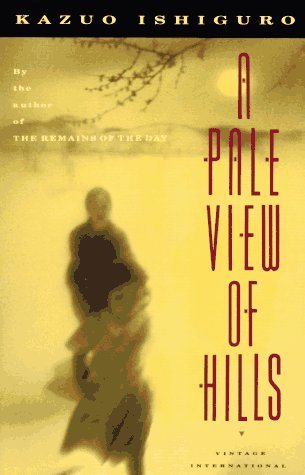
"A Pale View of Hills" by Kazuo Ishiguro

Published: 1982
Read: 2011
Genre: Fiction
Rating: 3
Lists: 1,001 books
Review: Goodreads


Ishiguro's first novel is haunting, reminding me of his other beautifully written work, Never Let Me Go, published in 2005.  In both books, a female narrator tells of what happens in her past.

Although I loved the prose, the narrative was frustrating.  I had lots of questions while reading which remained unanswered and after finishing, I wrote in the margin, "I don't get it - at all."  In situations like this, I rely on Goodreads and found that many others felt the same way.

Halfway through the book I questioned whether or not Etsuko Sharingham was a reliable narrator.  But I think the true question Ishiguro is exploring is would any of us be a reliable narrator in the same situation?  He answers via her musing:
Memory, I realize, can be an unreliable thing; often it is heavily colored by the circumstances in which one remembers, and no doubt this applies to certain of the recollections I have gathered here.
Is the same message within the title?  In my journal, while thinking of the word "pale" and with a thesaurus' help, I wrote the following:  washed out, weak, fragile, dim, faint, feeble, muted, faded, subtle and soft.   After reading the book, I think the title suggests that views of the past expressed in the book will be dim, faint, and muted or in other words, "pale".

Etsuko is a widow, living alone is some English village and at the beginning of the book, her daughter Niki, who lives in London is visiting.  We find out that six years earlier, Keiko, her daughter via her first husband, committed suicide while living in Manchester (horrible - she hung herself and was not found until a few days later).  Prior to that, Keiko lived at home but in self-imposed isolation from her family.  She did not interact with anyone, not her mother, step-father or step-sister...for years.  Very strange, bizarre behavior.  Why was this tolerated?

It is during Niki's visit that the story is told.  Etsuko's memories are prodded after some discussions with Niki about  the past.  An image of a little girl playing on a swing, seen while they are at a teashop, sticks with Etsuko, invades her dreams and causes her to remember people and situations when she lived in Japan.  So the narrative swings from present to past and in the end, is all tied to Keiko's suicide.

Within Etsuko's memories is another question that Ishiguro explores: what are the consequences of a mother's guilt?  In her case, was it so great, so intolerable, that she had to invent an alternate mother (Sachiko) and daughter (Mariko) in order to remember the past?  Is it possible for a person to disassociate from themselves so much that they create a fictional reality?  Maybe.  To me, this is a disturbing question.

As a survivor of suicide myself, I found this passage to be tragically true:
I have found myself continually bringing to mind that picture - of my daughter hanging in her room for days on end.  The horror of that image has never diminished but it has long ceased to be a morbid matter; as with a wound on one's own body, it is possible to develop an intimacy with the most disturbing of things.
I would recommend this book with the following caveat - beware of unanswered questions and an ambiguous ending.  If you do read it, I'd love to hear your thoughts.

Tuesday, August 9, 2011

"To Kill A Mockingbird" by Harper Lee

Published: 1960
Read: 2011
Genre: Fiction
Rating: 5
Review: Goodreads
Lists: Pultizer Prize (1961); 1,001 books


Harper Lee’s first and only novel published in 1960 was an immediate success, winning the Pulitzer Prize in 1961 and made into a movie with Gregory Peck as Atticus Finch in 1962 (in my Netflix queue). 

The story is told in the first person by an older Scout, looking back on her life growing up in Maycomb, Alabama with her father whom she calls Atticus, her older brother, Jem and their cook, Calpurnia.  Her mother died when she was young.  She is a likable protagonist, a tomboy with spirit, gumption and a lively imagination.  The most excitement in their idyllic, sheltered life comes from trying to draw out the reclusive and mysterious Boo Radley until Atticus takes on a case which polarizes the community and brings racial tension straight into Jem and Scout’s world.  In short. Atticus is asked to defend Tom Robinson, an innocent black man accused of raping a “white trash” young woman.  There are no witnesses, it is her word against his.

While I have wanted to read this book after finishing other books about adolescents such as Twain's The Adventures of Tom Sawyer and The Adventures of Huckleberry Finn, and J.D Salinger's The Catcher in the Rye, it went to the top of my TBR list after seeing her name in the dedication page of another recently read book, In Cold Blood by Truman Capote.  In fact, To Kill a Mockingbird is somewhat autobiographical as Lee grew up in the Deep South, loved to read (like Scout), her father was a lawyer (like Atticus) and one character, Dill was modeled after Capote.

Moral lessons abound within this quick read:

Atticus to Scout – on trying to teach her how to get along with people she may not agree with or understand:  
You never really understand a person until you consider things from his point of view…until you climb into his skin and walk around in it.

Miss Maudie (neighbor) to Scout about Atticus: 
"Atticus Finch is the same person in his house as he is in public" and "People in their right minds never take pride in their talents."
Atticus to Scout on why he took the Robinson case: 
"This case, Tom Robinson’s case, is something that goes to the essence of a man’s conscious.  I couldn’t go to church and worship God if I didn’t try to help that man" and "before I can live with other folks I’ve got to live with myself.  The one thing that doesn’t abide by majority rule is a person’s conscious."
Jem and Scout had watched the trial and with the black/white and right/wrong idealism of youth, he was angry at the verdict. Atticus' explanation to Jem:
The one place where a man ought to get a square deal is in a courtroom, be he any color of the rainbow, but people have a way of carrying their resentments right into a jury box.  As you grow older, you’ll see white men cheat black men every day of your life, but let me tell you something and don’t you forget it.  Whenever a white man does that to a black man, no matter who he is, how rich he is, or how fine a family he comes from, that white man is trash.
When Jem and Scout are talking about classes in Southern society: 
J – I’ve thought about it a lot lately and I’ve got it figured out.  There’s four kinds of folks in the world.  There’s the ordinary kind like us and the neighbors, there’s the kind like the Cunninghams out in the woods, the kind like the Ewells down at the dump and the Negroes. 
S - Naw, Jem, I think ther's just one kind of folks.  Folks.
J - That's what I thought too when I was your age.  If there's one kind of folks, why can't they get along with each other?  If they're all alike, why do they go out of their way to despise each other?
Notable passages

For some reason, I love this sentence (about Aunt Alexandra's husband):
She married a taciturn man who spent most of his time lying in a hammock by the river wondering if his trout lines were full.
About Dill:
Thus we came to know Dill as a pocket Merlin, whose head teemed with eccentric plans, strange longings, and quaint fancies.
Great description of Maycomb (long but I couldn't pare down - all good):
Maycomb was an old town, but it was a tired old town when I first knew it.  In rainy weather the streets turned to red slop; grass grew on the sidewalks, the courthouse sagged in the square.  Somehow, it was hotter then: a black dog suffered on a summer's day; bony mules hitched to Hoover carts flicked flies in the sweltering shade of the live oaks on the square.  Men's stiff collars wilted by nine in the morning.  Ladies bathed before noon, after their three-o'clock naps, and by nightfall were like soft teacakes with frostings of sweat and sweet talcum.
People moved slowly then.  They ambled across the square, shuffled in and out of the stores around it, took their time about everything.  A day was twenty-four hours long but seemed longer.  There was no hurry, for there was nowhere to go, nothing to buy and no money to buy it with, nothing to see outside the boundaires of Maycomb County.
On Scout's second cousin:
Talking to Francis gave me the sensation of settling slowly to the bottom of the ocean.  He was the most boring child I ever met.
When Jem and Scout visited Calpurnia's church:
The warm bittersweet smell of clean Negro welcomed us as we entered the church yard - Hearts of Love hairdressing mingled with asafoetida, snuff, Hoyt's Cologne, Brown's Mule, peppermint, and lilac talcum.
On why Aunt Alexandra was so irritable on the Lord's Day:
I guess it was her Sunday corset.  She was not fat, but solid, and she chose protective garments that drew up her bosom to giddy heights, pinched in her waist, flared out her rear, and managed to suggest that Aunt Alexandra's was once an hour-glass figure.  From any angle, it was formidable.
On being a Southern woman:
Why ladies hooked woolen rugs on boiling nights never became clear to me.
I must soon enter this world, where on its surface fragrant ladies rocked slowly, fanned gently and drank cool water.

Saturday, July 16, 2011

"In Cold Blood" by Truman Capote

Published: 1965
Read: 2011
Genre: Non-fiction novel or true crime novel
Rating: 5
List: 1,001
Review: Goodreads, A Guy's Moleskin Notebook


With this brilliantly written novel, Capote created a new genre: the non-fiction novel and/or the true crime novel.  It was initially published in four installments in the New Yorker and then in novel form in 1965.  Rather than writing a book full of facts about a horrific crime in a sleepy Midwestern town, Capote used these facts to create a spell-binding story.  Once started, I had a hard time putting the book down.  

The book is divided into four parts called I) The Last to See them Alive, II) Persons Unknown, III)  Answer and IV)  The Corner.  Within the parts are sections separated by white space, no chapters.

Capote and Harper Lee (author of To Kill A Mockingbird) went to Holcomb, KS, scene of the gruesome murders to conduct interviews.  He followed the story through the trial/sentencing and was able to interview the murderers while incarcerated.   There are two movies that depict this time in Capote's life, Capote and Infamous.  Both are in my Netflix queue.

Quotes to remember and why:

Rather than just listing items that accompany a guitar and 12-guage shotgun in the back seat of the car, Capote adds a literary flair:
A flashlight, a fishing knife, a pair of leather gloves, and a hunting vest fully packed with shells contributed further atmosphere to this curious still life.
If Dick's face truly looked like this, what a piece of descriptive writing:
...his face, which seemed composed of mismatching parts.  It was as though his head had been halved like an apple, then put together a fraction off center.
Even a cat is worthy of a well-constructed sentence:
Pete, a tiger-shaped tom weighing fifteen pounds, is a well-known character around Garden City, famous for his pugnacity, which was the cause of his current hospitalization; a battle lost to a boxer dog had left him with wounds necessitating both stitches and antibiotics.

This reminds me of Josh's glasses that are still in his room....
Upstairs in Kenyon;s room, on a shelf above his bed, the lenses of the dead boy's spectacles gleamed with reflected light.

When locals were getting on Dewey for not solving the crime at Hartman's cafe, Mrs. Hartman rebukes them with these three simple words which says it all.
Hush your meanness.
Dewey had worked on four simple murder cases before this one. I like how clear and concise this sentence is:
Prior to the Clutter mystery, the four cases cited were the sum of Dewey's experience with murder, and measured against the case confronting him, were squalls preceding a hurricane.
How Perry looked at the trial in a borrowed shirt and jeans cuffed at the bottom:
..he looked as lonely and inappropriate as a seagull in a wheat field.
Death, grief and suicide are prominent themes so I wrote a post on Josh's blog.

Saturday, July 9, 2011

"North and South" by Elizabeth Gaskell

Published: 1855
Read: 2011
Genre: Fiction
Rating: 5
Review Goodreads


Last year I watched an excellent adaptation by BBC, on the recommendation of my daughter.  Since then, I bought the Works of Elizabeth Gaskell on my Nook for a whopping $4.  I started to read this novel and found the highlighting and note-taking feature so cumbersome, I had to buy the paperback.  Now I can dog-ear, write in the margins and underline to my heart's content.   I have come to the conclusion that an e-reader is not necessarily my cup of tea unless I have a sudden urge to download and read a Debbie Macomber book in one night.

Gaskell was a wife and mother before becoming an author.  Her first book, Mary Barton (1848) made her an instant celebrity.  North and South was first published in the familiar installment mode in Dicken's Household Words between September 1854 and January 1855.  She became a lifelong friend of Charlotte Bronte and wrote a biography at the request of C.B's father.   Apparently North and South is of a similar theme to Bronte's book, Shirley (1849).

I loved the book: the prose, characters, setting, description and dialogue.  To me, it was Pride and Prejudice meets North and South.

Margaret Hale is our heroine and lives in an idyllic town in the south of England called Helstone.  Her father, a clergyman decides to leave the Church of England and take up a position as a tutor in Milton (northern England) much to the chagrin of his wife.  The family is uprooted and the difference in surroundings and lifestyle are like night and day.  Milton is a manufacturing town and one of Mr. Hale's pupils is a factory owner, John Thornton.

Through an omniscient narrator that goes inside the minds of both main characters, Margaret and John, we see the differences between these two parts of England - almost as if they were different countries.  The North vs South themes in the book:  apprentice vs. student, pragmatic vs. philosopher, man vs. gentleman, manufacturing vs. agriculture.  The other themes have to do with the manufacturing industry itself:  Master vs. hand, management vs. labor, owner vs. union.

Both Margaret and John have pride in their way of doing things and are prejudiced against the other, hence the similarity to Austen's book which was published over 40 years earlier, in 1813. In fact, chapter 11 is titled "First Impression" which was the original title of P&P.

The basic romance plot line of Margaret Hale and John Thornton remind me of Elizabeth Bennett and Mr. Darcy in Austen's P&P and interestingly enough, Scarlett O'Hara and Rhett Butler in Margaret Mitchell's Gone With the Wind.

  • Boy and girl notice one another (Mr. Darcy and Elizabeth at the dance, Mr. Thornton and Margaret at her Milton home, Rhett and Scarlett at the Wilkes' barbecue).
  • Boy is attracted to the girl first and professes his love.
  • Girl rejects boy.
  • Boy saves girl.
  • Girl sees the positive attributes in boy.
  • Some misunderstandings which drive me as the reader, crazy.
  • Girl ends up loving boy. 

I look forward to reading other novels by both Gaskell and Bronte.
  • Mary Barton (1848)
  • Shirley by C.Bronte (1849)
  • Cranford (1853)
  • Life of Charlotte Bronte (1857)
  • Wives and Daughters (1866)
It is a bit surprising how much I am enjoying 19th century British literature. 

Tuesday, July 5, 2011

"Mentor: A Memoir" by Tom Grimes

Published: 2010
Read: 2011
Genre: Memoir
Rating: 3
Reviews: Goodreads


My reading journey has led me to the world of memoirs.  I remember seeing this book last year and made a mental note.  During a Border's closing sale a few months ago, it was purchased and added to the ever growing TBR pile.   I picked it up before going on a 2-day business trip last week, thinking it would be a perfect airport-airplane read while providing some food for thought - a good choice.  

This poignant memoir is about the impact of a mentor, Frank Conroy, director of the prestigious Iowa Writer's Workshop on a fledgling writer, Tom Grimes.  It also offers a glimpse into a writer's life and if accurate, it is a lonely, difficult, anxiety ridden, insecure life.  Why would anyone want to do this?  I ask the same question when reading articles about people who want to run a marathon in every continent or about a 51 year old man who recently biked from California to the East Coast in 11 days - why??  I guess it is a calling or maybe a better description - an obsession.

Meaningful quotes below:

Grimes' reasons for writing:
Writing was my center of gravity.  If I quit, I'd implode.
It's my way of controlling my world and my emotions.  I focus on sentences.  For several hours a day, nothing else matters.  I live inside language.  And while I'm often frustrated by writing's difficulty, I am also at peace.
Writing is a necessity.  I exist on sentences.  I forget my sense of failure.  I forget time. I forget that I'm aging.  I forget that one day I'll die.  Revising sentences is an act of hope, and connecting to the reader is the only leap of faith I'll ever take. 
I never want to die and when I'm writing a novel I believe I never will.  
I can relate to some of Grimes' feelings.  About how writing is a centering activity and a way to work through intense feelings.  I've had to rely on writing to survive our personal earthquake, the suicide of our beloved 17-year old son.  In the aftermath, during the wee hours of the night, words flowed from pen to paper.  Into my journal, then onto Josh's blog.  Then onto this reading blog.  And over 2 year later, I have not stopped.  I try to be as true and uncensored as possible - about what I am feeling and thinking.  It has been a lifesaver.

Difficulty of a writer's life:
The ground a writer stands on is no firmer than water.
I've chosen a profession and life that promises to humble me.
The six months I'd spent hunched over my desk in a small cold room near an ice-glazed storm window had ended.  I felt as if I'd ascended from the ocean's frigid, black floor, broken the water's surface and taken a deep breath.  A world did exist apart from the intensity of making sentences and the anxiety of scratching my way toward an ending.
Interesting thought about the connection between writer and reader, as imparted to Tom by Frank.
A reader must feel the continual, but unobtrusive pressure of the writer's soul behind every sentence.

Very good example of "show, don't tell".  Grimes is in the locker room of a pro baseball team, for research purposes. In my book, I underlined the adjectives and circled the verbs. 
First they pulled long, white socks above their knees and secured them with navy blue stirrups.  Next, they hoisted jock straps over their hips, stepped into spandex shorts and then reached inside them to snugly place a hard rubber cup over their testicles.  They tugged short-sleeved Mets T-shirts over their heads, slipped into immaculate white, blue and orange pinstriped uniforms, and then knotted the laces of their polished black cleats. 

Tom's very graphic, intense description of his sister's attempted suicide.  Horrible.  She tried to disembowel herself with a carving knife.  This didn't work so she plugged in an electric carving knife and slit her left wrist.  The noise woke up her husband and two young children.  When the boys saw her covered in blood, "she seemed to be wearing a horror mask. The boys began tearing at their hair, trying to rip it from their skulls.  As he dialed 911, they ran into the dining room and circled it's table, shrieking."

When Tom was diagnosed as clinically insane - his haunting, descriptive metaphor:
I felt like an eggshell that had been dyed with vivid colors, then pinpricked and drained.  It may appear solid, but beneath its decorative surface it's hollow and nearly weightless.
Takeaways:
Read Frank Conroy's critically acclaimed memoir, published in 1967: Stop-Time

Thursday, June 30, 2011

"The Catcher in the Rye" by J. D. Salinger: Read-A-Long

Published: 1951
Read: 2011
Genre: Fiction
Setting: NYC 1949
Rating: 5
List: 1,001
Review: Goodreads


Love it, love it, love it.  And I am only in the first couple chapters.  I hope this love affair will continue.  Because I am getting so much out of my reading, thinking and journaling through the chapters, I want to take my time.  So it will be my own "read-a-long" with no structure or deadline.  The links to the posts (on Josh's blog) are below.

Chapters 1-3   (posted 6/7/11)
Chapters 4 - 10  (posted 6/13/11)
Chapters 11 - end   (posted 6/30/11)

This book reminds me of The Adventures of Huckleberry Finn by Mark Twain as both protagonists are adolescent boys who are non-conformists at heart, challenging and rebelling against social expectations, not because they are bad but more because they do not see the point.  They look at adults with skepticism and distrust, having seen clear evidence of hypocrisy and in Holden's word, phoniness.

Twain and Salinger excel at capturing the thoughts, musings and speech of the boys, each in their respective time periods. Of the two master plots in fiction, "stranger comes to town" and "hero takes a journey", both are the latter.

I would re-read, but for different reasons.  Twain's story chronicles the adventures of Huck and Jim, a run-away slave, as they travel down the Mississippi River on a raft.  Although Huck is an uneducated, homeless boy, his honest, simple and genuine character shines through, making for a "feel good" story.

Salinger's story is much darker.  Holden is alone in his journey which leads him to an increasingly depressed state.  My interest this book stems from trying to glean whatever I can, via fiction or non-fiction sources, the fragile state of an adolescent boy's mind.  To help me better understand what could've been going on in my beloved boy's head.

Takeaways:  Read other books about adolescents

  • To Kill A Mockingbird by Harper Lee
  • Anne Frank: The Diary of a Young Girl by Anne Frank